
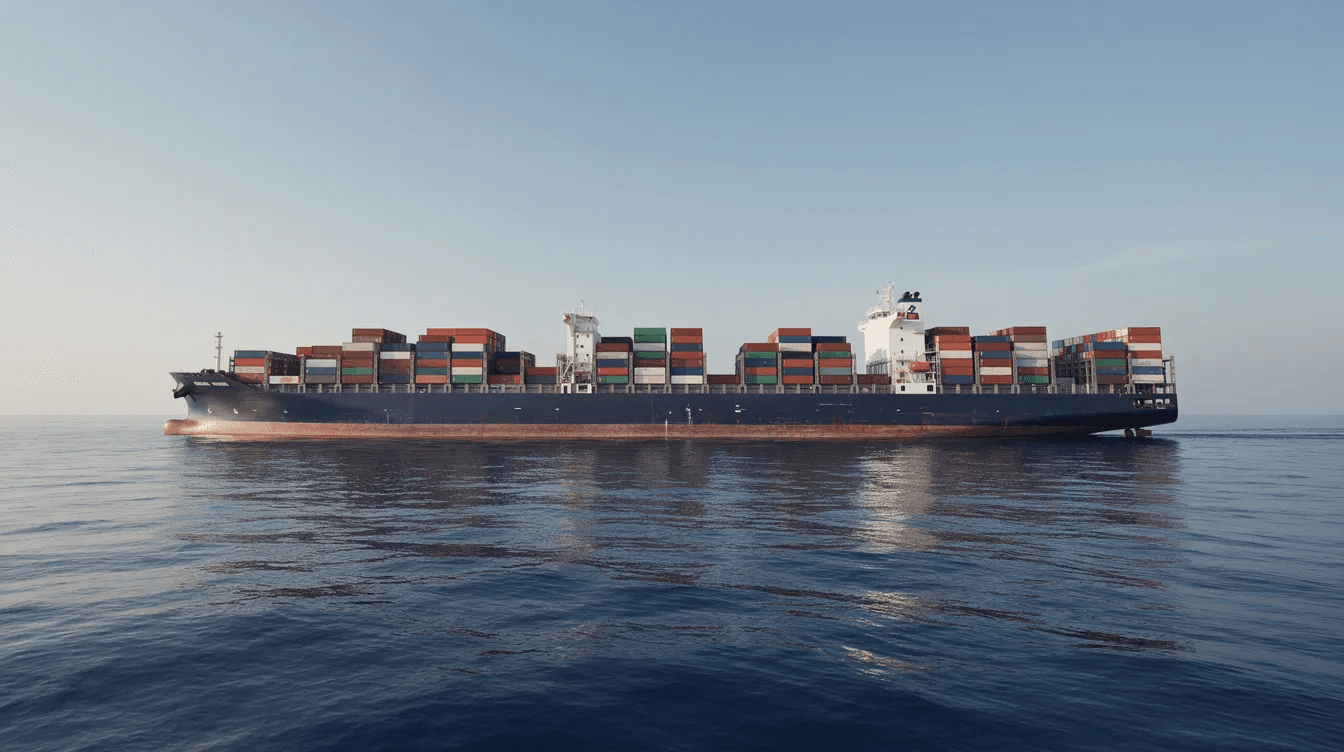
Ship stability is the ability of a vessel to return to an upright position after being tilted by wind, waves, cargo shifts or manoeuvres. Every officer, superintendent and shipowner needs a working knowledge of the forces, reference points and regulatory criteria that keep a floating ship safe. This guide covers the core principles, from metacentric height to damage stability, with the numbers and operational context that matter in daily fleet management.
Key Takeaways
- Ship stability depends mainly on weight distribution, hull form, center of gravity and buoyancy. Three reference points define the physics: center of gravity (G), center of buoyancy (B) and the metacentre (M). The metacentric height (GM) drives initial stability and the initial slope of the GZ curve.
- The International Maritime Organization regulates stability through the 2008 Intact Stability Code and SOLAS probabilistic damage stability rules. Nautilus Shipping manages compliance with both frameworks for client fleets.
- Free surface effect and free surface correction can reduce GM by tenths of a metre when multiple slack tanks exist, especially during ballast and fuel operations. A tank one-tenth full produces the same free surface effect as one nine-tenths full.
- Officers must check corrected GM, a complete GZ curve and all intact stability criteria in the approved stability booklet or loading computer before departure. A single GM value is not enough.
Fundamentals of Ship Stability: Why It Matters for Safe Operations
Stability is critical to prevent capsizing, protect crew and cargo, and maintain seaworthiness. High winds, waves or cargo shifts create forces that influence a vessel’s stability, and every commercial vessel type faces these forces differently. A bulk carrier loaded with iron ore sits low in the water with a high-density cargo concentrated below deck; a container ship stacks boxes high above the waterline, raising the center of gravity. Each hull form and cargo distribution produces a different stability profile.
Intact stability refers to the undamaged condition of the hull. Damage stability addresses what happens after structural failure floods one or more compartments. Both are essential for modern commercial vessels, and both are governed by international rules including SOLAS, the Load Line Convention and the 2008 Intact Stability Code. Stability is essential for the safety of the crew, passengers, cargo and vessel.
The interaction of gravity, buoyancy and righting moments is fundamental to ship stability. As a ship management company, Nautilus Shipping integrates stability assessments into technical management, voyage planning and crew training for owner clients, ensuring that every loading condition meets regulatory and operational standards.
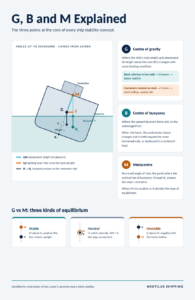
The Three Critical Points: Centre of Gravity, Centre of Buoyancy and Metacentre
Understanding G, B and M is the core of all ship stability concepts in naval architecture.
The center of gravity (G) is the point where the ship’s total weight acts downward. Its vertical position above the keel (KG) changes with every loading condition: adding heavy steel coils low in a cargo hold lowers G, while stacking containers on deck raises it. A higher center of gravity makes a ship more susceptible to excessive rolling and capsizing. A lower center of gravity generally improves stability.
The center of buoyancy (B) is where the upward buoyant force acts on the submerged volume of the hull. When a ship heels, the underwater hull shape changes, and the center of buoyancy shifts toward the more immersed side, on the starboard side if the vessel heels to starboard.
The metacentre (M) is a point called the intersection of the buoyant force’s vertical line (at a small heel angle) with the ship’s centreline when the vessel is in the upright condition. The relative vertical position of G and M determines whether the floating body is in stable equilibrium, neutral equilibrium or unstable equilibrium.
Initial Stability and Metacentric Height (GM)
Initial stability describes how a ship behaves at small angles of heel, typically up to about 10°. It is governed by metacentric height. GM is the vertical distance between G and M, calculated as GM = KM − KG. KM comes from hydrostatic data provided by the shipyard and depends on hull form, draft and displacement. KG depends on the weight acting downward through the ship’s structure, cargo, fuel and ballast tanks.
A positive GM indicates a restoring moment for stability; the vessel returns upright after a small heel. A positive GM means the metacentre is above the centre of gravity. Large GM (1.5 to 2.0 m) creates a stiff ship with rapid rolling and short roll periods of 6 to 8 seconds. Small GM (0.3 to 0.5 m) results in a tender ship with slow rolling and roll periods of 12 to 16 seconds; container ships and car carriers often fall in this range.
Worked example: A vessel has KM = 5.50 m and KG = 5.00 m. GM = 5.50 − 5.00 = 0.50 m. After free surface correction of 0.15 m, corrected GM = 0.35 m. This ship’s initial stability produces a moderate roll period (roughly 10 to 12 seconds) and meets the 0.15 m minimum, but the officer must still verify the full GZ curve, not rely on GM alone.
Positive GM is necessary but not sufficient for overall intact stability compliance. Large-angle behaviour and downflooding limits are not captured by a single number. Nautilus Shipping monitors GM across loading conditions as part of fleet support, comparing actual corrected GM against the vessel’s approved stability limits.
The Righting Arm (GZ) Curve and Initial Slope
The GZ curve is the plot of the righting arm (GZ) versus heel angle. It is the main picture of a vessel’s stability for a given loading condition. The righting arm is the horizontal distance between the lines of action of buoyancy (upward buoyant force) and weight. At larger angles, the GZ curve describes stability beyond 10° of heel, where the simple GM approximation breaks down.
For small angles, GZ ≈ GM × sin(ϕ). With GM = 0.60 m at 10° heel, GZ ≈ 0.60 × 0.174 = 0.10 m. The ship’s initial stability sets the initial slope of this curve. If you know GM, you know the curve’s steepness near 0°.
Key features of a complete GZ curve:
- Initial slope: proportional to GM
- Maximum GZ: indicates the ship’s resistance to large heel angles; must occur at 25° or more per IMO criteria
- Range of positive stability: the band of heel angles where a positive righting arm exists
- Angle of vanishing stability: where GZ returns to zero; beyond this angle no righting moment acts
- Area under the curve: represents dynamic stability energy available to resist external heeling moments
Separate stability curves are prepared for each loading condition (ballast voyage, departure loaded, arrival loaded, homogeneous cargo, part loads) in the approved trim and stability booklet or approved loading computer. Nautilus Shipping’s technical teams review client vessels’ GZ curves when auditing stability documentation.
Intact Stability Criteria and Regulatory Framework
Intact stability criteria ensure that ships have sufficient righting ability under normal, undamaged conditions. The IMO 2008 Intact Stability Code (Resolution MSC.267(85)), mandatory since 1 July 2010, sets the baseline. The IMO Intact Stability Code sets a minimum GM of 0.15 metres. Proper load distribution prevents the ship from being top-heavy or excessively tender.
| Criterion | Minimum Value |
|---|---|
| Corrected GM | ≥ 0.15 m |
| GZ at 30° heel | ≥ 0.20 m |
| Angle of maximum GZ | ≥ 25° |
| Area under GZ curve, 0°–30° | ≥ 0.055 m·rad |
| Area under GZ curve, 0°–40° | ≥ 0.090 m·rad |
| Area under GZ curve, 30°–40° | ≥ 0.030 m·rad |
These criteria differ by vessel type. Passenger ships, fishing vessels and container ships each have specific requirements. Owners must follow the vessel’s specific approved stability booklet and the load line protocol rather than generic tables. Nautilus Shipping supports shipowners by verifying that all working loading patterns are covered by approved intact stability conditions and that loading computer software stays updated.
Free Surface, Free Surface Effect and Free Surface Correction
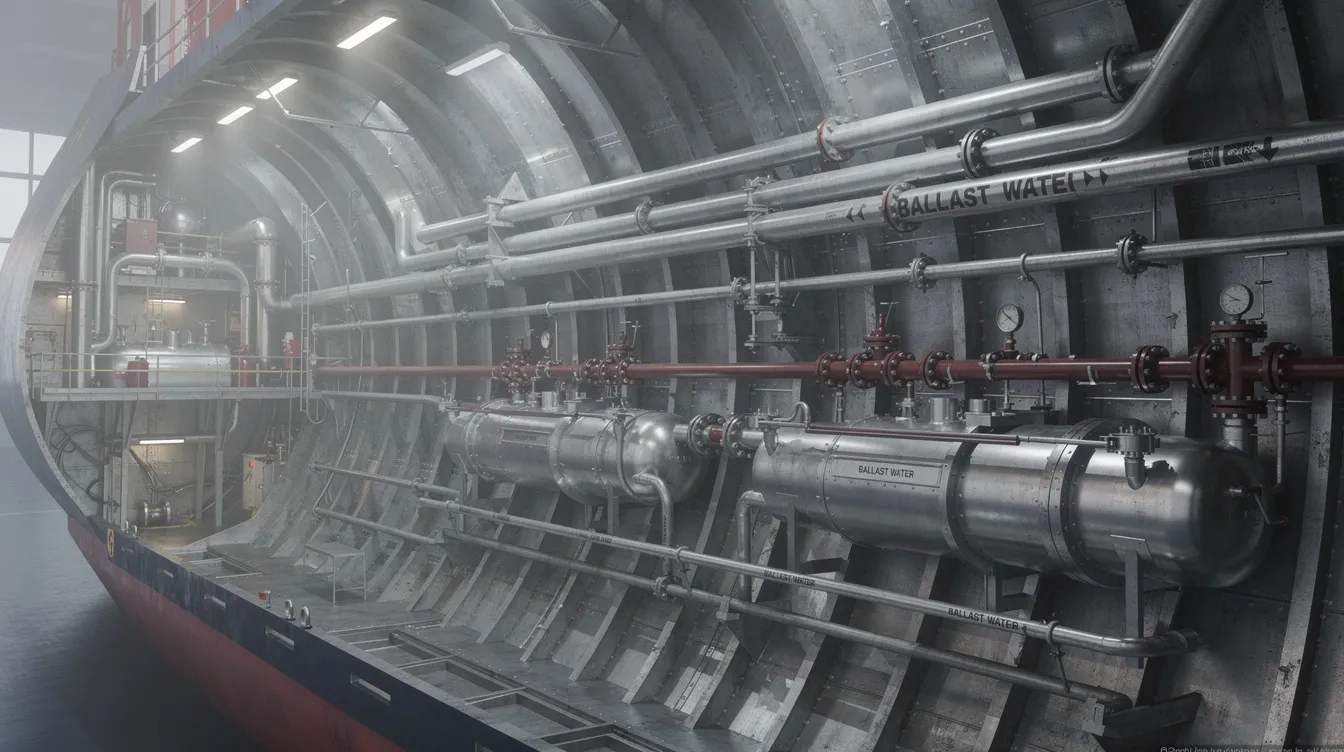
A free surface forms whenever a liquid (ballast water, fuel, cargo oil) sits in partially filled tanks. When the ship rolls, that liquid surface shifts toward the lower side, creating a heeling moment that subtracts from the vessel’s righting ability.
The free surface effect reduces effective GM by shifting the centre of gravity virtually upward. The free surface moment depends on the breadth of the liquid surface, not on the volume of liquid. A wide, shallow tank produces a far larger correction than a narrow, deep one. A tank one-tenth full has the same free surface effect as one nine-tenths full, because both have nearly the same liquid surface area exposed.
Free surface correction (FSC) is subtracted from the solid GM to obtain corrected GM: GM(corrected) = GM(solid) − FSC. The correction formula involves the moment of inertia of the liquid surface, the liquid density and the ship’s displacement. Free surface effect acts like raising the ship’s center of gravity, even though no physical weight shift occurs.
Operational best practices:
- Avoid multiple slack tanks; keep ballast tanks either pressed full or empty
- Use longitudinal subdivision and swash bulkheads where fitted
- Plan sequential ballast and fuel transfers to minimise cumulative free surface effect
- Minimizing slack tanks is crucial for maintaining stability, especially on tankers and bulkers trading ballast-intensive routes
Equilibrium Conditions: Positive, Neutral and Negative GM
The relative positions of G and M define three equilibrium states for any floating body.
Stable equilibrium occurs when G is below M. The righting moment returns a ship to the upright position. A loaded bulk carrier often operates with GM of 0.30 to 1.00 m, producing greater initial stability and a positive righting arm at small heel angles. Positive GM means the vessel will return upright after heeling.
Neutral equilibrium happens when G coincides with M. GM is zero. The stability curve has no initial slope, and the vessel feels dead in the roll. Any external heeling moment, even a modest beam wind or a transverse weight shift on the starboard side, can push the ship to an unpredictable angle. This condition demands immediate corrective action.
Unstable equilibrium occurs when G is above M, producing a negative GM. The upright position becomes unstable, and the vessel may settle at an angle of heel. Negative GM indicates unstable equilibrium and risk of capsizing. A ship with negative GM is at risk of capsizing. If officers encounter a low or negative GM situation with an unexpected persistent heel, the correct response is to lower G by adding ballast low in double-bottom tanks, not by shifting cargo sideways. A negative initial GM must be corrected before the vessel proceeds to sea.
Longitudinal Stability, Trim and Operational Upsetting Moments
Longitudinal stability governs how a floating ship resists trim changes about a transverse axis. The longitudinal metacentric height (GML) is much larger than transverse GM; for most vessels, GML runs to tens or hundreds of metres, so the ship resists pitch far more than roll.
Weight shifts along the ship length (loading containers forward, consuming fuel from aft tanks, shifting heavy project cargo) move the longitudinal centre of gravity and cause trim by the bow or stern. The Moment to Change Trim by 1 cm (MCT1cm) from hydrostatic data quantifies how much moment is needed.
Common external upsetting moments that challenge transverse stability:
- Beam winds create heeling moments that affect stability; weather criteria in the IS Code compare wind heeling against the GZ curve
- Turning manoeuvres at ship speed generate centrifugal forces
- Lifting heavy weights with ship’s cranes creates a transverse weight shift
- Dynamic stability responds to external forces creating heeling moments that challenge recovery
Nautilus Shipping’s commercial and technical teams consider both transverse and longitudinal stability when planning loading patterns, ensuring acceptable drafts, trims and stability margins for each voyage leg.
Damage Stability: Surviving Flooding and Regulatory Expectations
Damage stability is the vessel’s ability to remain afloat and stable after hull damage and flooding. Vessels must manage water ingress to maintain buoyancy and stability. Under SOLAS Chapter II-1, most cargo and passenger ships must satisfy a probabilistic approach: the attained subdivision index (A) must equal or exceed the required index (R). A = Σ(pᵢ × sᵢ), summing the probability of each damage scenario times its survival probability, which depends on residual righting lever and range of positive stability after flooding. Ship survival after damage depends on subdivision, hull integrity and crew response.
Flooding reduces buoyancy, can introduce large free surface effects in damaged spaces, and shifts G and B unfavourably. Officers rely on the damage control plan, flooding contingency procedures and stability guidance in emergency situations. Stability calculations for damage cases use approved software and shipyard data.
Nautilus Shipping ensures that vessels maintain updated damage stability documentation and that crews are trained through drills and exercises on reading damage stability information, cross-flooding procedures and emergency ballast transfers.
Stability Management in Daily Operations at Nautilus Shipping
A stability assessment is not a one-time exercise. It runs through every loading condition, every bunkering stop and every cargo operation across a vessel’s life cycle.
On board, the chief officer uses the trim and stability booklet and the approved loading computer to check GM, GZ curves, intact stability criteria, longitudinal stability and free surface corrections before departure. Nautilus Shipping’s procedures require cross-checks by the master and shore technical superintendent, with attention to cargo distribution, bunkers and ballast stowage.
Fleet support teams monitor stability-related risks over the vessel’s life cycle. After retrofits (scrubbers, ballast water treatment systems, new cranes), lightship weight and KG change. Nautilus Shipping coordinates inclining tests, updates stability booklets and verifies class approval. Crew management includes regular stability training modules covering angle-of-loll recognition, free surface management and loading computer operation, building decision-making confidence where it counts most: at sea.
Frequently Asked Questions on Ship Stability Basics
How often should ship stability be checked during a voyage?
Stability should be checked before departure, after any cargo or ballast change, before entering heavy weather and whenever unexpected heel, trim or rolling behaviour is observed. Nautilus Shipping’s SMS requires formal stability checks at key operational stages: after bunkering, completion of cargo operations and major ballast transfers.
Can a ship still be stable if the centre of gravity is above the centre of buoyancy?
What matters for the ship’s initial stability is the position of G relative to M, not directly to B. Many ships operate safely with G above B because the metacentre remains above G, producing a positive GM. Officers should use KM and KG from the stability booklet or loading computer for their stability assessment rather than relying on intuitive notions of G versus B.
What is the practical difference between intact stability and damage stability in daily work?
Intact stability is checked routinely for every loading condition via the loading computer. Damage stability is embedded into design and emergency procedures. In emergencies, officers consult the damage control plan and pre-calculated damage stability cases to decide on counter-flooding, ballast transfers and course or speed adjustments.
How does free surface effect influence intact stability criteria compliance?
Free surface effect reduces effective GM by shifting weight virtually upward. An otherwise compliant loading condition on a solid GM basis can fail intact stability criteria once free surface correction is applied. Operators must always use free-surface-corrected GM and confirm that the slack tank configuration matches those assumed in approved loading conditions.
What support can a shipowner expect from Nautilus Shipping on stability matters?
Nautilus Shipping assists owners with reviewing and updating stability documentation, calibrating loading computers, performing lightship checks and training crews in stability management. Technical superintendents and marine superintendents support masters in complex stability situations, including unusual project cargoes, retrofits and post-incident assessments.